Published on 11/01/2026 · by Leandro Caldas, glazier, founder of Routeck and creator of the Arena
MIG welding for beginners: what the Arena do Vidro final showed
MIG welding for beginners: that is exactly what the Arena do Vidro final put on the bench. The challenge was a mirror with a metal frame, made of square tube, that had to stand on its own, in 60 minutes. And one of the two competitors had never used that kind of welder.
I built the challenge that way on purpose. The idea of the Arena is to push glaziers out of their comfort zone and make them face something they have never done. In this post I go through what happened with the welding in the final and what it teaches anyone who works with mirrors and wants to start making metal frames in their own glass shop. The full episode is in the video above.
A glazier who had never welded, in a R$ 10,000 final
Before the machine was even on, I had warned that Janael would say he had never used a welder. At the bench the talk went that way: with this one, never, only stick, and no idea how to use it. At another moment you hear “welding, I don’t know how, none, zero.” Janael later summed it up: welding was another weak spot for him.
On the other side, Rômulo had never welded either and still got it fast. I said it on the spot: we put a good machine in his hand, you just pull the trigger and weld, he understood that and it was coming out well.

Why MIG is the shortest path for a beginner
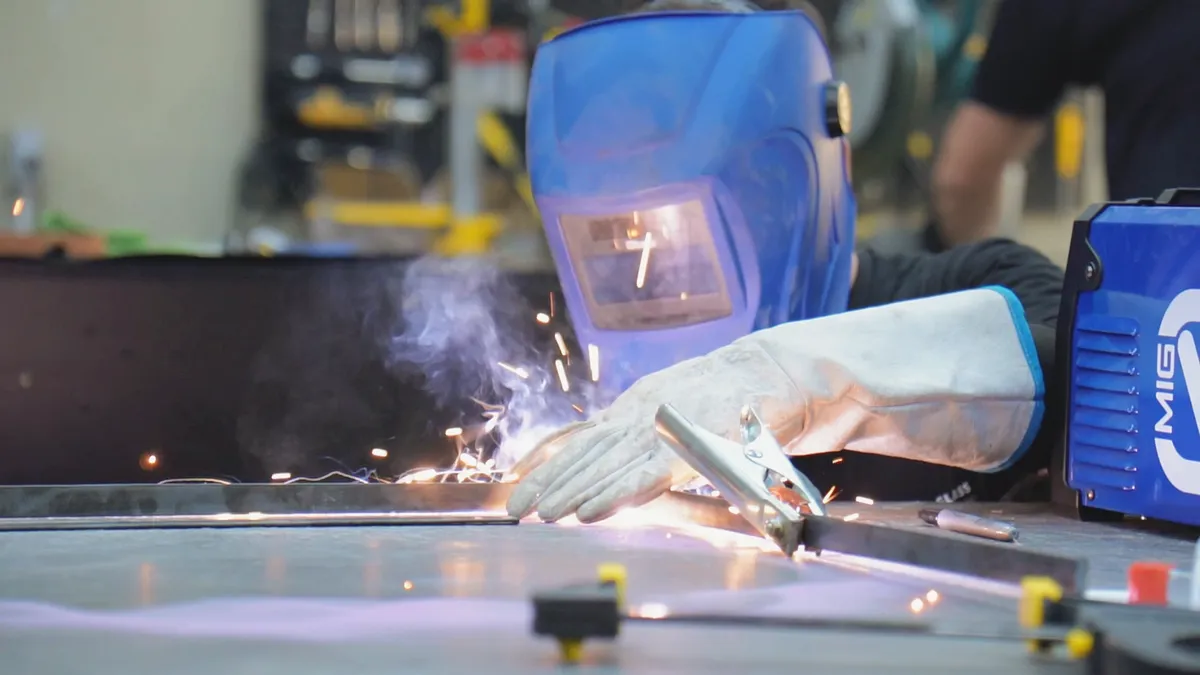
This is general shop knowledge, not a test result. With stick welding you hold the rod, strike the arc, keep the distance while the rod burns down, swap rods and chip the slag. With MIG the wire feeds through the gun on its own when you pull the trigger. Your hand only handles angle and travel speed.
That is why people who never welded usually pick up MIG faster, especially on square tube and thin flat bar, which is what we use for mirror frames. The final showed it: someone who had never welded closed the frame and the stand within the time.
Welding pulls: the detail beginners forget
Knowing how to weld does not solve everything. Rômulo himself said after the challenge that he slipped: he knew welding pulls the metal and still cut the mirror right to the frame size. Once he welded, the frame closed up, the mirror no longer fit and could crack. He had to trim about 2 cm off the mirror and cut and weld the tube again.
If you are starting out with MIG welding, keep this in mind before any bead technique:
- Leave clearance between the frame opening and the mirror. Heat expands the metal and it pulls as it cools.
- Tack the corners first and then run the beads, switching sides, so the frame does not warp to one side.
- Weld the frame without the mirror inside. Spatter marks glass and mirror.
- Check square and inside size after welding, before cutting the final glass.
When to call someone who knows
In the final, from minute 10 on, each competitor could call Rui or Peterson, two metalwork specialists, for 10 minutes of hands-on help: sanding, welding, whatever was needed.
Janael planned for that from the start. When Rui stepped in, the design was ready, and in under 10 minutes the frame was welded and he was on the stand. Rui, who has 10 years in this trade, summed it up: the project was ready, he just executed it. The final score was 29.37 to 27.12 for Janael.
Your glass shop works the same way. If welding is still your weak spot, learn MIG calmly on small parts and, meanwhile, hand a drawn and measured big frame to a metalworker. The expensive mistake is not asking for help. It is asking for help with a half-finished plan.
Safety gear before you strike an arc
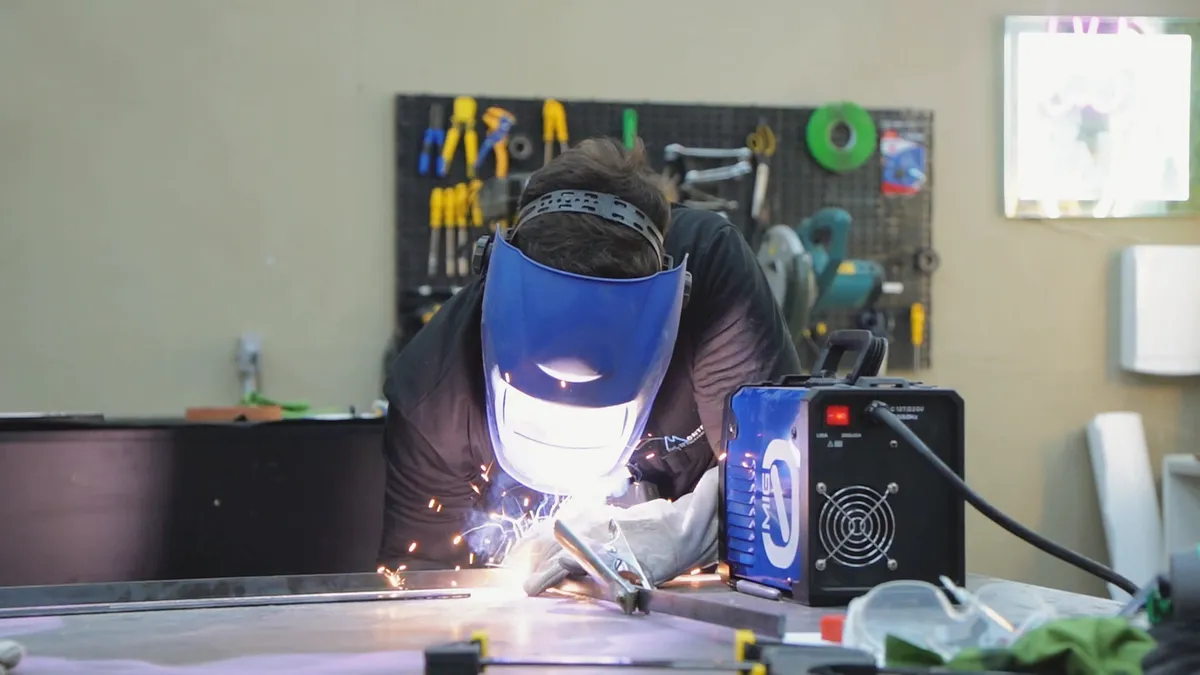
In the final everyone welded with a welding helmet and leather gloves. That is the minimum. Add long sleeves, safety glasses under the helmet for grinding, good ventilation and nothing flammable near the bench. Keep finished mirrors away too: spatter and sparks ruin them.
- Is MIG welding easy for someone who never welded?
- It is the simplest to start with, because the wire feeds through the gun on its own. In the Arena do Vidro final, a competitor who had never welded built the frame within 60 minutes.
- How much clearance between a metal frame and the mirror?
- It depends on size and metal, so I will not throw out a number. What the final showed is that a mirror cut exactly to size will not fit once the weld pulls the frame: leave a few millimeters and measure again after welding.
- Can I weld with the mirror inside the frame?
- No. Spatter marks the glass and heat can crack it. Weld the frame, check the size and only then put the mirror in.
Want to talk about metal mirror frames in your glass shop? Message me on WhatsApp at +55 31 9095-8383. And if you want to show your method at the bench, applications for the next season of Arena are open here on the site.
Full episode 4 · The Arena do Vidro final · Framed mirror measurements: cutting 2 cm to save the deadline · How to plan a framed mirror before cutting metal