Published on 11/14/2026 · by Leandro Caldas, glazier, founder of Routeck and creator of the Arena
Sandblasted mirror with LED: strip on the edge or inside curve?
A sandblasted mirror with LED looks simple on paper: blast it, stick the strip on the back and switch it on. In practice, where the strip runs decides whether the whole mirror lights up or one corner stays dark. In Arena do Vidro EP1, the model I put on the bench had exactly that: a Hello Kitty shape, a sandblasted band and LED lighting on the back, with a touch switch.
The video above is the last stretch of the episode, the assembly. That is where Janael, who got to the lighting first, said honestly what he had done and what was missing. That is what this post is about: a strip only along the outside, or one on the inside curve too.
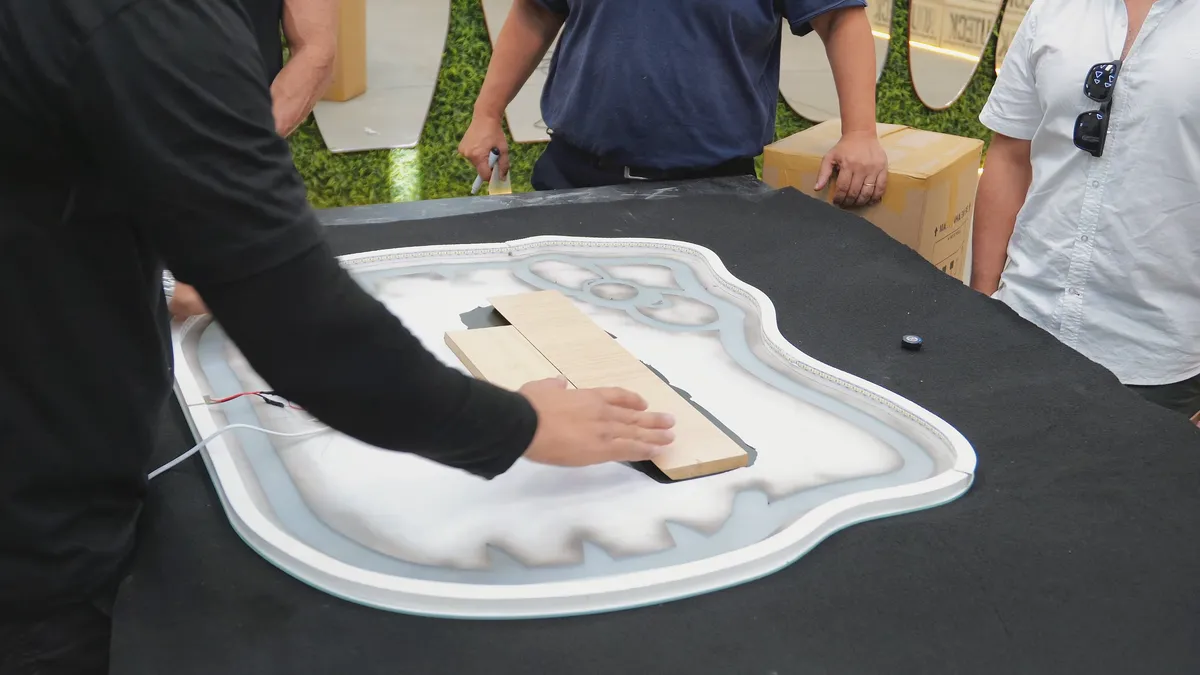
Sandblasted mirror with LED: light only gets through where you blasted
On a mirror lit from behind, sandblasting removes the silvering in the design area. That is the only place light comes through. Where the mirror coating is still there, the strip can be on right behind it and nobody sees a thing. That is why the blast design and the strip path have to be planned together, before you stick down the first inch.
It also explains why the judges paid so much attention to the sandblasted band in the EP1 evaluation. The width and length of the blast are not just looks: they are the size of the window the light comes out of. A wider band needs light spread more evenly behind it.

Outside edge only, or the inside curve too
When I asked whether the lighting would turn out well, Janael was straight about it. Because of the clock, he set up the lighting to cover the blast and the inner area as best he could. But in his words, with a little more time he would have run a curve on the inside too, with another LED strip, to get better lighting. And he admitted that part was going to be a bit darker.
That is the read of someone who knows the product. On an organic shape, a strip that only follows the outside outline ends up far from the curves that cut into the design. Light fades with distance, and the inside curve is the first spot to go dark. A second strip following the inside curve shortens that distance.
- Draw the strip path on top of the blast design, before sandblasting.
- Mark the curves that cut into the shape: they go dark first.
- Where the gap between the strip and the blast gets large, plan a second strip.
- On tight curves, cut the strip at its marked cut points and join it, instead of forcing the bend.
- Test the strip lit up before closing the mirror.
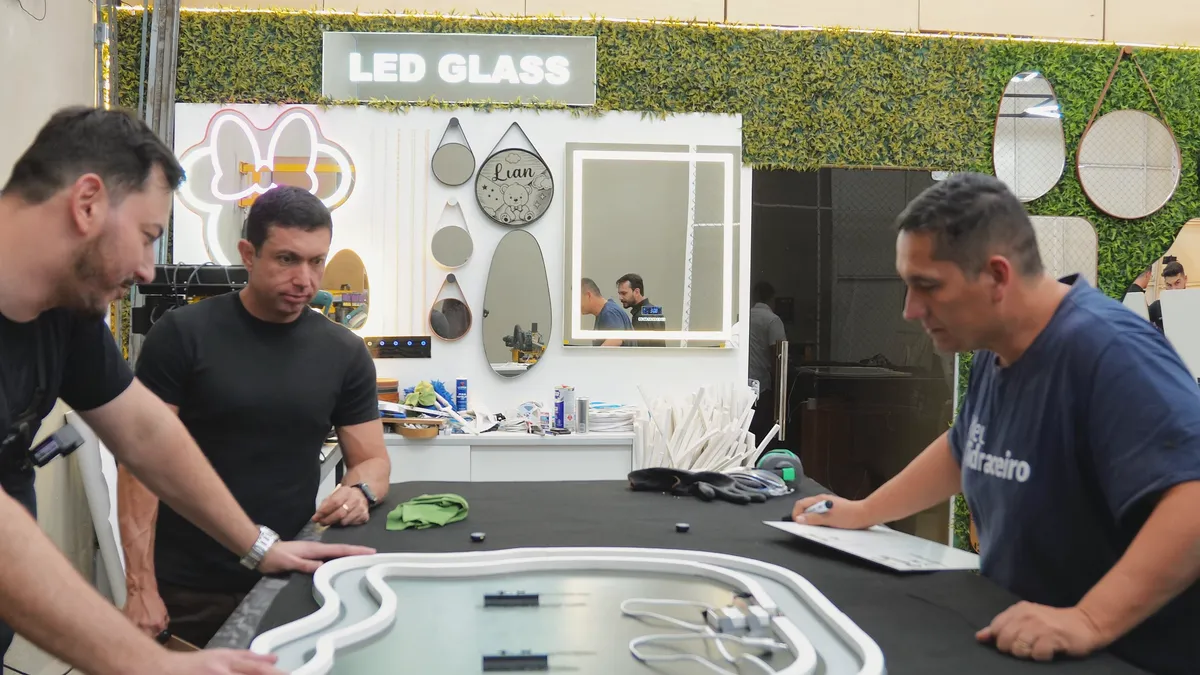
The surface behind the mirror counts too
Janael was also counting on one more thing: once the mirror was mounted in place, the surface behind it would help the lighting a little. It makes sense. Light leaking out the back hits the surface behind the mirror and bounces back. A light-colored surface returns more light; a dark one swallows it. You just cannot count on that to fix a dark curve, because the customer can hang the mirror on any wall.
| Where the strip goes | Result | When to use it |
|---|---|---|
| Outside outline only | Lit edge, darker inside curve | Simple shapes or a narrow blasted band |
| Outline + inside curve | More even light across the design | Organic shapes with curves that cut in |
| Strip following the blasted band itself | The whole band lights up | When the band is the main feature |
What EP1 teaches anyone making LED mirrors
The lesson is not to always use two strips. It is to plan the light together with the blast and with the time you have. Janael knew what he would do with more time and chose to deliver on schedule. In a glass shop there is a deadline too, but the decision can be made earlier, in the design, not when you are gluing. The Hello Kitty blast was done on the Jateck, our mess-free sandblaster.
- Why does my sandblasted LED mirror have a dark area?
- Because light only gets through where the blast removed the silvering, and it fades with distance from the strip. On an organic shape, the inside curve is far from a strip stuck along the outline, so it goes dark first.
- Do I need an LED strip on the inside curve of the mirror?
- On shapes with curves that cut into the design, it helps. In EP1, Janael said that with more time he would have added a curve on the inside with another strip to light it better.
- Does the wall behind the mirror change the lighting?
- Yes. Light leaking out the back hits the surface and bounces: a light surface returns more, a dark one less. But you cannot rely on it, because every customer has a different wall.
Want to talk about LED mirrors? Message me on WhatsApp at +55 31 9095-8383.
Full episode 1 · How to judge a finished LED mirror · Dust-free mirror sandblasting · Jateck: mess-free sandblaster · Test the LED strip before gluing the mirror