Published on 11/03/2026 · by Leandro Caldas, glazier, founder of Routeck and creator of the Arena
Freehand glass cutting: when keeping the straight edge saves a mirror
Freehand glass cutting has a mistake that does not even look like one: messing with what is already right. In EP3 of Arena do Vidro the sheet already had a straight cut, and one judge expected that to be used. Instead, they went to take off a small chip, and the edge ended up worse than it was.
In this post I put together what the show revealed about working freehand, plus the shop rule for deciding when to keep the edge and when to cut. The full EP3 is at the top of this post (audio in Portuguese), and this scene is a little after the 8-minute mark.
What the judge pointed out in EP3
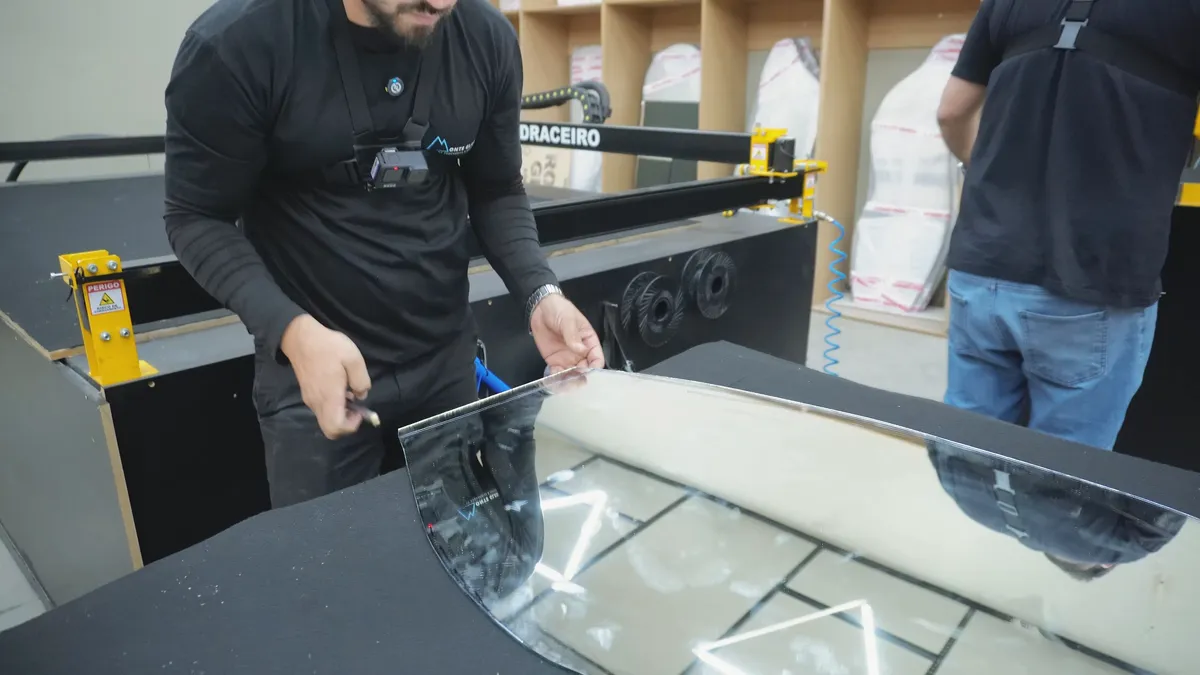
This was the judging of Rômulo’s mirror, with the caliper already on the table. The judge praised the accuracy, but showed the marks left by tapping the glass, and then talked about the edge: “a strategy I thought you’d follow at the end, which was keeping the straight cut.” He added: “the sheet was already cut straight. Then you went to take off a little chip, and here it got more crooked.” He also pointed out the run lines that showed up, and finished: “it ended up compromising the result.”
Two things to tell this right. First, nobody actually showed a kept edge in the challenge. The judge was talking about what he expected to see, so the “saves” in the title is shop reasoning, not a scene from the show. Second, the crack in Rômulo’s mirror was a different mistake, at the break-out. He explained it himself: he made both score lines before breaking out, and the cut ran inward.

What the episodes showed about freehand work
- EP3, Rômulo, after the tie: “I have a lot of trouble with these freehand cuts.” He corrected himself right away: the problem was not the cut, it was “scoring, drawing there, that’s terrible for me.”
- EP3, Janael, at the end of the challenge: “I’m terrible at manual work.”
- EP1, Rômulo. There the hand cutting was on the sandblast vinyl, not the glass, but the logic holds. He said that in his shop he uses templates he made himself for organic cuts with sharp curves, because he knows that limitation. Without them, he made a copy of his template on the spot.
What I take from this: good freehand work does not mean doing everything by hand. It means knowing what your hand does badly and finding support. The straight edge of the sheet is the cheapest support there is, because it is already done.
Why a finished edge beats a touch-up
From here on this is shop knowledge. Every pass of the cutter is one more chance to leave the line. An edge that is already straight has no such risk: nobody improves a straight line by hand by taking off a little. And a thin strip is the one that breaks out worst, because it has no body to lever against. In the final, the judges recommended leaving at least half a centimeter to take off, and the pliers post tells that story.
| Situation | What I do |
|---|---|
| The shape has a straight section and the sheet edge is good | Keep it and draw the curve from there |
| The edge has chips or is out of square | Cut it, with a strip of at least half a centimeter |
| The shape is all curves | Use the edge only as a measuring reference |
How to use the edge in freehand glass cutting
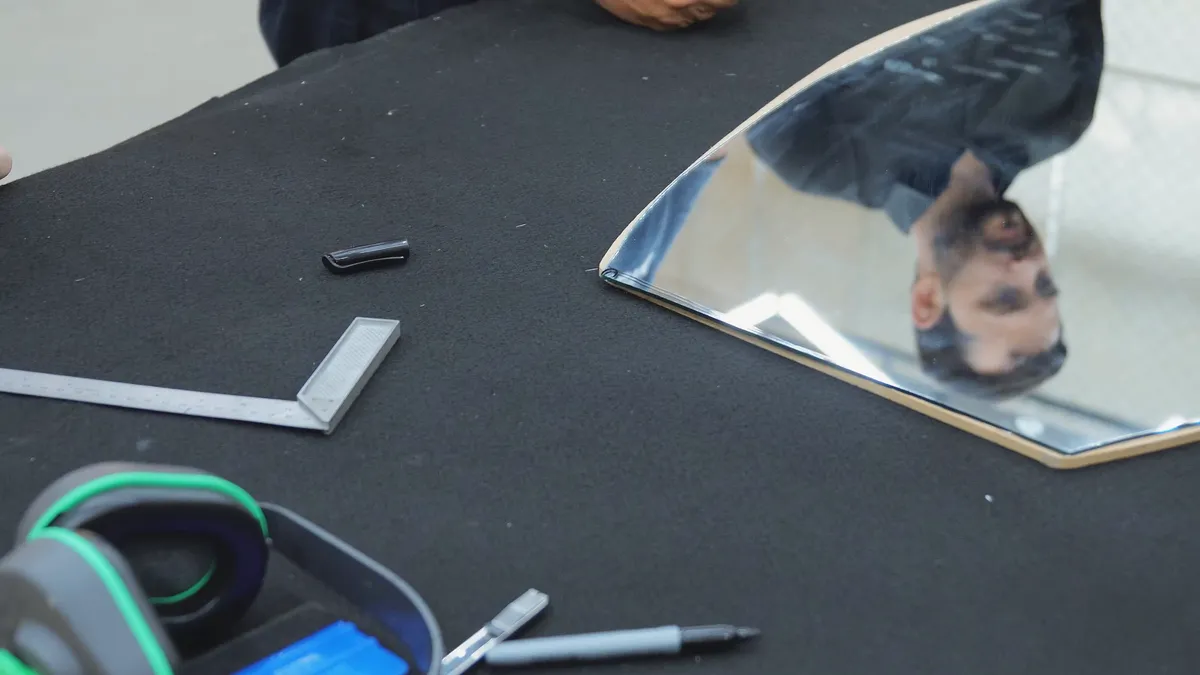
- Check the edge with a ruler or square before you trust it.
- Line up the straight part of the drawing with the edge before drawing any curve.
- Score in one pass and open it without tapping. It was said at the table: “when you keep tapping, you keep creating these marks here.”
- Finished, and it is within what the job needs? Stop. The nervous touch-up is what ruins the piece.
Vinícius left the message at the end of the challenge: if they had used at least 10% of what the judges had been saying all day, they could have gotten a better result. And when the shape is curved all the way around, the math changes. That is why I said in the episode that with the Router Glass I would cut that mirror in about a minute.
- Is it worth recutting an edge that is already straight?
- If it is good, no. In EP3, taking a small chip off a sheet that was already cut straight left the mirror more crooked, and the judge said it compromised the result.
- How much should I leave when I really have to cut the edge?
- In the Arena final the recommendation was at least half a centimeter. A thinner strip has no body to lever against and leaves teeth.
- Is freehand cutting done only by eye?
- It does not have to be. Rômulo said in EP1 that he uses templates he made himself for sharp curves. The sheet edge, a ruler and a template are all support, and there is no shame in that.
Want to talk about cutting glass in your shop? Message me on WhatsApp at +55 31 9095-8383. And if you cut well by hand, applications for the next season of Arena are open here on the site.
Full episode 3 · Glass grozing pliers: why thin strips leave teeth · Glass cutting accuracy: the caliper at the EP3 judges’ table · Router Glass