Published on 11/16/2026 · by Leandro Caldas, glazier, founder of Routeck and creator of the Arena
Mirror sandblasting machine: inside the Jateck, with no dust
In the first episode of Arena do Vidro, the mirror sandblasting machine caught both contestants off guard. Janael and Rômulo had never used the Jateck, both of them sandblast in a booth at their own shops, and both expected a hard time. They found it easy, and one of them ended up talking about convenience and cleanliness.
That day there was no time to explain why the machine behaves that way. The video in this post does it: I open the Jateck and show the path the air and the oxide take. Here I put the two together, what they felt during the challenge and the part of the machine that explains each reaction.
"At my shop we have a booth"
One contestant described his everyday sandblasting: a fully sealed booth, Tyvek coveralls over his whole body, a special mask, and so much dust in the air that visibility drops. The other put it his own way: you put on all that gear, masks everywhere, and dust that never ends.
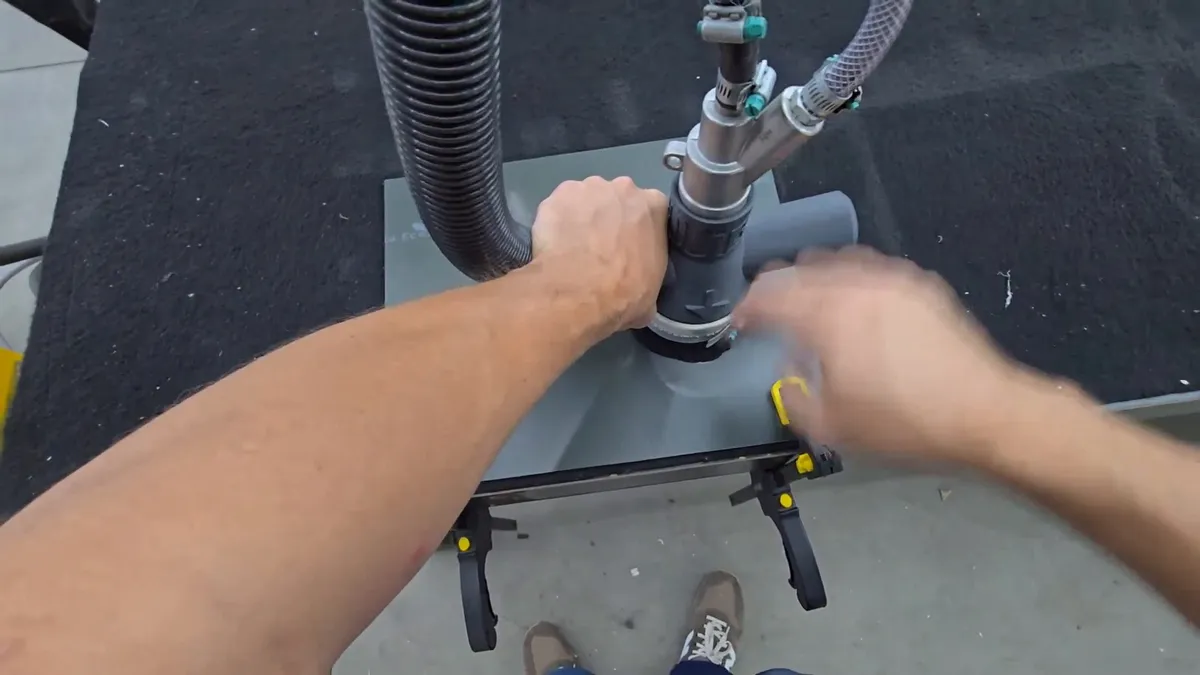
The booth exists because the abrasive, after it hits the glass, has nowhere to go except the air and the floor. On the Jateck, it does. The nozzle takes air from one side and oxide from the other, the two mix and hit the glass. Right after impact, the oxide is pulled back into the machine by the built-in suction, and the fine dust is trapped in a 40 micron filter.
That is what both of them saw in the Arena without knowing the name for it: sandblasting happening at the bench, next to the other steps, with no dust cloud. Protective gear is still good practice in any sandblasting, but the mess that forces you to have a booth practically never leaves the machine.

"I thought I would struggle to handle it"
Both said that, the first time, they expected trouble, and that it went smoothly. It makes sense once you count the controls on the machine:
- Air inlet, where you hook up the compressor.
- Pressure gauge, to set the pressure between 5 and 7 bar.
- Oxide valve, which lets more or less abrasive out with the air.
- Power switch, on the back of the machine, 220 V single phase.
There is no booth door, no gloves fixed to a window, no separate extractor to adjust. If you already know how to sandblast, all that changes is where the sandblasting happens.
"Done edging, and it goes straight to sandblasting"
My favorite comment during the challenge was about deadlines. According to the person who said it, the biggest problem today is outsourcing: any job that leaves the shop costs you time. There, he finished edging, peeled the film and went straight to sandblasting.
That only works because the machine fits in the shop: 90 × 30 × 30 cm and 30 kg. It is not a room, it is a piece of equipment that sits next to edging and assembly. And because the oxide returns to the tank, you can reuse the abrasive for months instead of sweeping it off the floor.
Mirror sandblasting machine: what your shop needs to repeat the Arena
| Item | What it takes | Included with the machine? |
|---|---|---|
| Compressor | At least 15 CFM, between 5 and 7 bar (around 200 L and 3 HP) | No |
| Abrasive | 25 kg of 100 grit aluminum oxide | No |
| Power | 220 V single phase outlet | Not applicable |
| Hoses and cover | To take the blast to the glass | Yes |
The Jateck is made by Routeck in Contagem, Brazil, and is patent pending in Brazil. Spec sheet, warranty and terms are on the machine's page: routeck.com.br/en/machines/jateck.
- Which sandblaster did the contestants use in Arena do Vidro?
- The Jateck. On EP1, both of them used it for the first time, on the sandblasted band of the Hello Kitty mirror.
- Why does the Jateck not spread dust like a booth?
- Because after the oxide hits the glass, it is pulled back into the machine by the built-in suction, and the fine dust stays in a 40 micron filter.
- Does the Jateck use sand?
- No. It uses 100 grit aluminum oxide. The compressor and the abrasive are on the glazier.
Do you sandblast in a booth and want to know if your compressor is enough? Message me on WhatsApp at +55 31 9095-8383. And if you think you would do the sandblasting step faster than those two, sign-ups for the next season are open on this site.
Their first time on the Jateck · Sandblast vinyl on mirrors: wet or strips · Episode 1: the Hello Kitty mirror