Published on 10/31/2026 · by Leandro Caldas, glazier, founder of Routeck and creator of the Arena
Organic Mirror: What Arena do Vidro Showed, From Cutting to Selling
The organic mirror is the shape of the moment: free curves, no straight corners, something the customer recognizes from across the room. In the first season of Arena do Vidro it showed up in four different moments, and each one shows a stage every glazier faces: liking the shape, cutting it, edging it and selling it.
In this post I put those four scenes together, with what each person said at the bench, and turn them into a step-by-step for your glass shop. The full season is in the video above.
Why the organic mirror became a trend
At the start of episode 3, Janael Hipólito talked about what he likes making most: decorative mirrors with frames and LEDs, and among them organic mirrors, which in his words are “the trend right now”. He has worked with mirrors for about 7 to 8 years and said he does it because he has to support his family, but that he loves what he does.
The message is useful for anyone starting out: the organic mirror does not compete on price with the rectangular shelf mirror. It sells as a decor piece. Whoever makes this kind of piece with clean finishing, with LED or a frame, leaves the price-per-square-meter conversation.
How to cut an organic mirror: template, hand or machine
Cutting a free curve is where most people get stuck. In episode 1, Rômulo Sullivan was honest: he said he is not very comfortable with cutting and that is why, at his shop, he has several templates he built himself, which he uses a lot for organic cuts with sharper curves. In the challenge, without his templates, he tried by hand, saw it was not going to work and rebuilt a piece of his template to make the cut. In his words, by hand it would not have come out even as well as it did.
In episode 3 the challenge was exactly that: cut by hand, in 20 minutes, one of two curved shapes exactly like the template, without placing the template on the mirror. About 10 minutes in, neither contestant had gotten the outline right, and the hardest part was transferring the outline to the glass, not cutting it. The jury called it a tie: one mirror cracked and the other came out crooked.
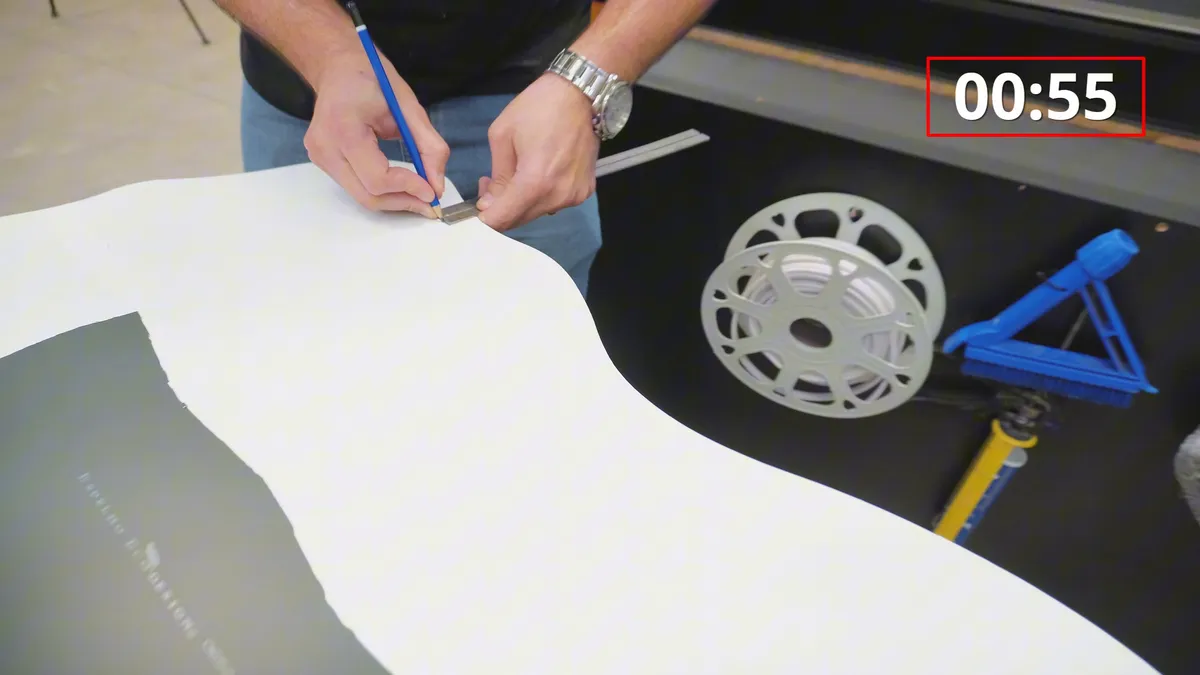
In the middle of that challenge I mentioned that with the Router Glass I cut a mirror in any shape, and that one I would cut in about a minute, alone. The machine's spec sheet describes cutting mirrors and glass in organic, round, oval or custom shapes, with ±0.5 mm accuracy. But the reasoning applies to any method:
| Method | When it makes sense | The risk |
|---|---|---|
| By hand, score and break out | One-off piece, simple shape, steady hands | Transferring the drawing and breaking out the waste: where episode 3 got stuck |
| Template | A shape that repeats, like Rômulo does at his shop | The template has to be faithful; its every error is repeated on every piece |
| CNC machine | Volume and varied shapes without relying on the hand | Needs the design in software and the machine in the shop |
Edging an inside curve: where organic gets expensive
You cut it, now you edge it, and that is where organic charges the price. In episode 1, someone at the judges' table put it simply: edging an organic mirror, the inward curve, takes know-how. Without it, either the mirror breaks or the finish does not come out. One contestant said he only finished because Vinícius, from the judges' table, gave him a technique: lower the machine's speed a little and change the tilt. I covered that scene in another post, the one on edging a curved mirror without breaking it.
The practical rule is to practice the inside curve on an offcut before touching the customer's piece. The outside curve is more forgiving; the inward one is where glass chips.
Selling an organic mirror: the customer sees the shape
In the episode 2 selling challenge, one contestant approached a woman on the street with the mirror in hand and went straight to it: “Is it a pretty mirror like this one? Look. Organic.” Before knowing the price, she guessed it would be worth about 150 reais. The contestant confirmed the mirror cost 150. The shape did the work of value, with no technical pitch.
That challenge was not about price, it was about losing the shyness of offering, and both contestants ended up selling for very low amounts, which I told in the post about the 35-second sale. But the scene shows the essential: the customer notices the different mirror before you explain the cut.
Step by step to make organic mirrors in your shop
- Draw the shape on paper and check that the inside curves are not too tight to edge.
- Pick the cutting method: template for repeats, machine for volume and variety, hand only for simple pieces.
- Test edging the inside curve on an offcut before cutting the final piece.
- Decide the finish before cutting: LED behind, a frame or a plain edge change the clearance and the lead time.
- Sell on the shape and the finish, not just on the size of the sheet.
- What is an organic mirror?
- A free-form mirror with curves and no straight corners, usually decorative, with a frame or LED. On Arena do Vidro, Janael called it “the trend right now”.
- How do you cut an organic mirror?
- With a template, by hand or on a CNC machine. By hand takes practice transferring the drawing and breaking out the waste; a template suits shapes that repeat; the machine cuts the shape straight from the design.
- Is edging an inward curve harder?
- Yes. In episode 1 the judges' table and the contestants said the inside curve takes know-how and can break the mirror. Practice on offcuts and adjust the speed and tilt of the edging machine.
Want to talk about organic mirrors, cutting or edging? Message me on WhatsApp at +55 31 9095-8383. And if you cut curves with steady hands, applications for the next season of Arena are open here on the site.
Full episode 3 · How to edge a curved mirror without breaking it · How to sell a mirror on the street in 35 seconds · How to cut a mirror into shapes