Published on 11/13/2026 · by Leandro Caldas, glazier, founder of Routeck and creator of the Arena
Scoring glass with a diamond cutter: steady pressure, one pass
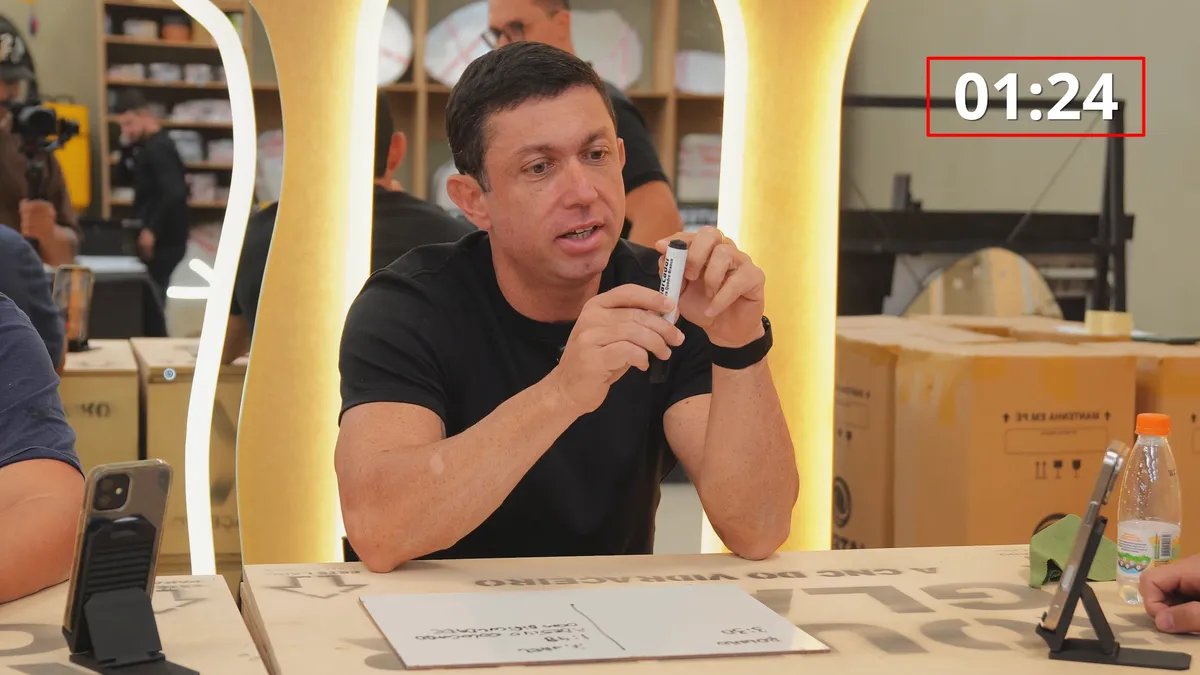
Scoring glass with a diamond cutter is the first thing every glazier learns and the last thing they stop correcting. On Arena do Vidro, it showed up in the first minutes of EP1. While the two contestants were breaking out the Hello Kitty mirror, Vinícius, a judge with 30 years in the glass trade, picked up a cutter from the judges' table and explained the tool part by part.
That moment is in the video above. I picked it because at the end of the season the judges came back to the same subject: in EP3, when giving the verdict, Vinícius said they had discussed the way both contestants used the cutter and the way they broke out the glass. In other words, the problem was not only the hand doing the cutting. It was how the tool was being used.
What glaziers mean by "diamond"
At the table, Vinícius put it simply: here is the diamond head, where it cuts, and here is where the fluid goes. In Brazil, a lot of glaziers call the whole cutter "the diamond". At the tip there is a small cutting wheel, which is what actually scores the glass. The body holds a light oil that runs down to the wheel and keeps the score clean.
Before any rule, he made a point: every glazier works a little differently. I agree. But some things about the score do not change from one glass shop to the next, because they come from how glass behaves, not from personal taste.

Scoring glass with a diamond cutter: the right pressure
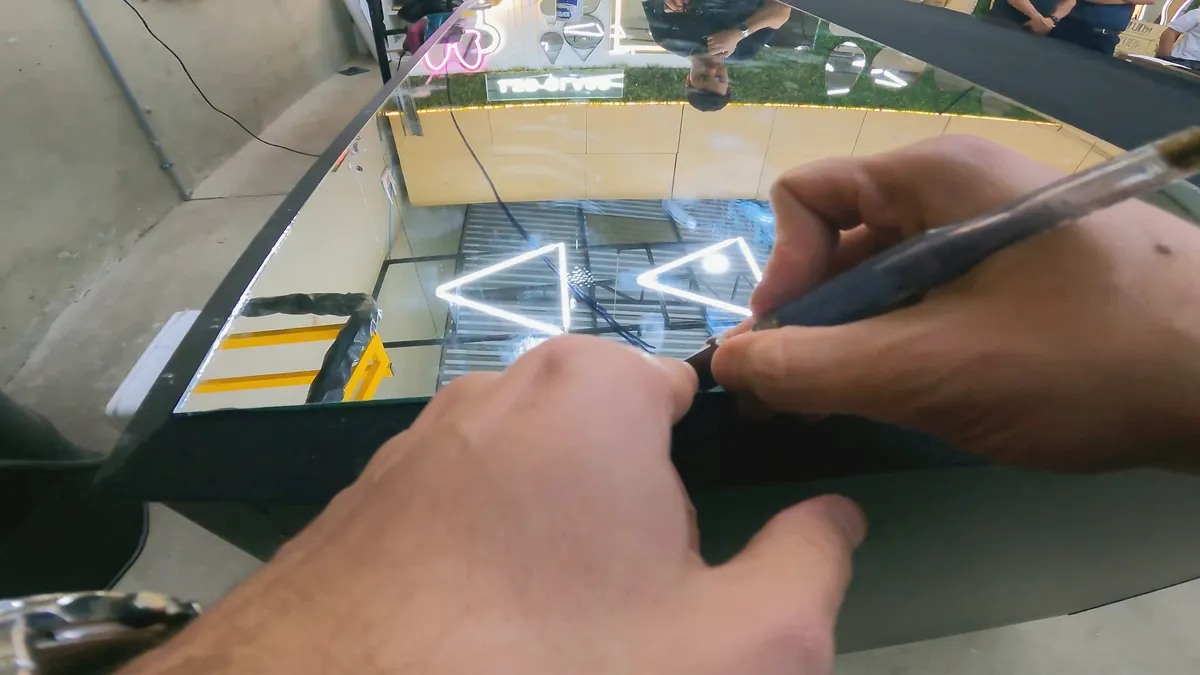
The score does not cut through the glass. It opens a thin fissure on the surface, and that fissure guides the break when you snap it. That is why pressure has to be firm and even from start to finish. Too little pressure and the score skips in spots, so the glass breaks wherever it wants. Too much and the wheel crushes the surface, the line turns white and flaky, and the edge comes out rough.
- On a mirror, always score the glass side, never the painted back.
- Hold the cutter upright, without tilting the wheel to one side.
- Keep a steady speed: no dragging, no rushing.
- Listen: a good score makes a thin, continuous hiss. A gritty sound means too much pressure.
- Keep oil in the cutter. A dry wheel skips.
One pass only: why the score cannot skip
This is the most common beginner mistake: the score skipped in one stretch, so you run the wheel over it again. It feels like a fix, but it is the opposite. The second pass hits a fissure that is already open, chips the edge and creates two paths for the break. When you snap it, the glass picks one of them, and not always the one you wanted.
If the score skipped, it is better to break out what opened and deal with the bad stretch afterwards, or to score a new line next to it, in the offcut. On a curved mirror this matters even more, because every skip becomes a run line, and run lines are exactly what the judges pointed out in EP3.
Tapping with the cutter: the judges do not all agree
After scoring comes opening the cut, and that is where glaziers disagree. Vinícius said that, back when he still cut mirrors by hand, he used to tap with the diamond end. And he answered the criticism before it came: a lot of people say that blows the glass apart. On a mirror, tapping with the ball on the end of the cutter is what causes the small shell chip in the backing, and Vinícius himself pointed that out in EP1. So if you tap with the cutter, use the diamond end, never the ball. And the technique he taught for opening the cut is the "cascudinho": a light tap with your hand, under the glass, from below, turning the piece until the whole score opens, as shown in the post on breaking out a mirror without chipping, linked at the end.
One of the contestants, on the other hand, said the break-out in EP1 went smoothly: when he pushed, the cut kept opening well. That is the simplest proof the score was good. When the fissure is continuous, the glass opens without a fight. When you have to tap a lot to open it, the problem almost always started earlier, in the score.
| What you see on the score | What it means | What to do |
|---|---|---|
| Thin, almost invisible, continuous line | Right pressure | Break it out right away |
| White line with dust and flakes | Too much pressure | Ease up on the next piece |
| Stretches where the score disappears | Too little pressure or a dry wheel | Do not go over it; break out and fix the cutter |
| Score drifting off the mark | Hand or straightedge out of place | Hold the straightedge firmly and slow down |
When a machine does the scoring
By hand, scoring depends on pressure, speed and focus all at once, and a timer makes it worse. On the Router Glass, a CNC router for glass and mirrors, the machine controls the pressure and the path of the score, and the shape comes straight from the drawing. Still, the glazier is the one who breaks out, edges and checks the piece, and understanding the score helps at every one of those steps.
- How much pressure should I use when scoring glass with a diamond cutter?
- Firm and even from start to finish. A good score is thin and continuous and makes a clean hiss; a white, crushed line means too much pressure, and a line that disappears means too little.
- Can I run the cutter twice over the same score?
- It is not a good idea. The second pass chips the edge and creates two paths for the break. If it skipped, break out what opened or score a new line.
- What is the oil in the glass cutter for?
- It lubricates the cutting wheel and keeps the score clean. In EP1, the judge showed it: the cutting head on one end, and the place where the fluid goes on the other.
Want to talk about cutting mirrors? Message me on WhatsApp at +55 31 9095-8383.
Full episode 1 · How to break out a mirror without chipping · Freehand glass cutting · Router Glass: the machine does the scoring