Published on 11/15/2026 · by Leandro Caldas, glazier, founder of Routeck and creator of the Arena
Cracked mirror: what to do right away (Arena do Vidro lessons)
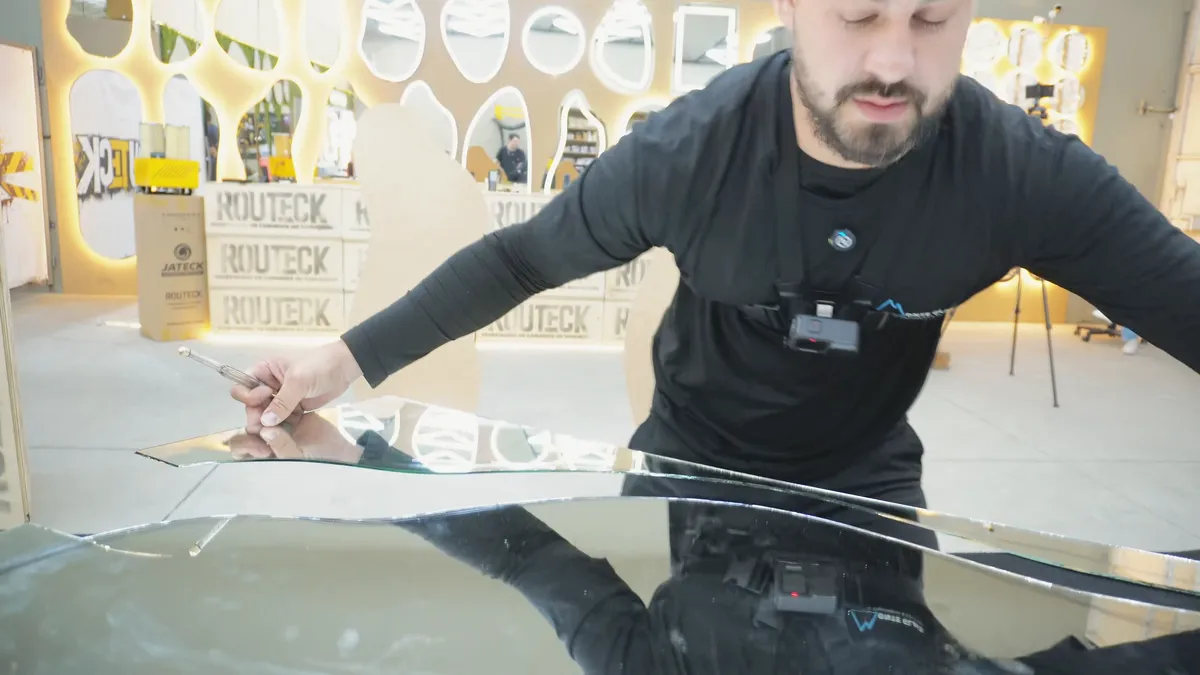
Cracked mirror, what to do? Every glazier knows that sharp snap and the silence right after it. In Arena do Vidro EP3 it happened on camera, a few minutes before the end of a hand-cutting challenge, on the mirror that was closest to the template.
The full episode is in the video above. Why it cracked has already been covered in other posts on this blog. Here I want to talk about the next minute: what you do with the piece in your hand, the clock running and the crack sitting there, staring back at you.
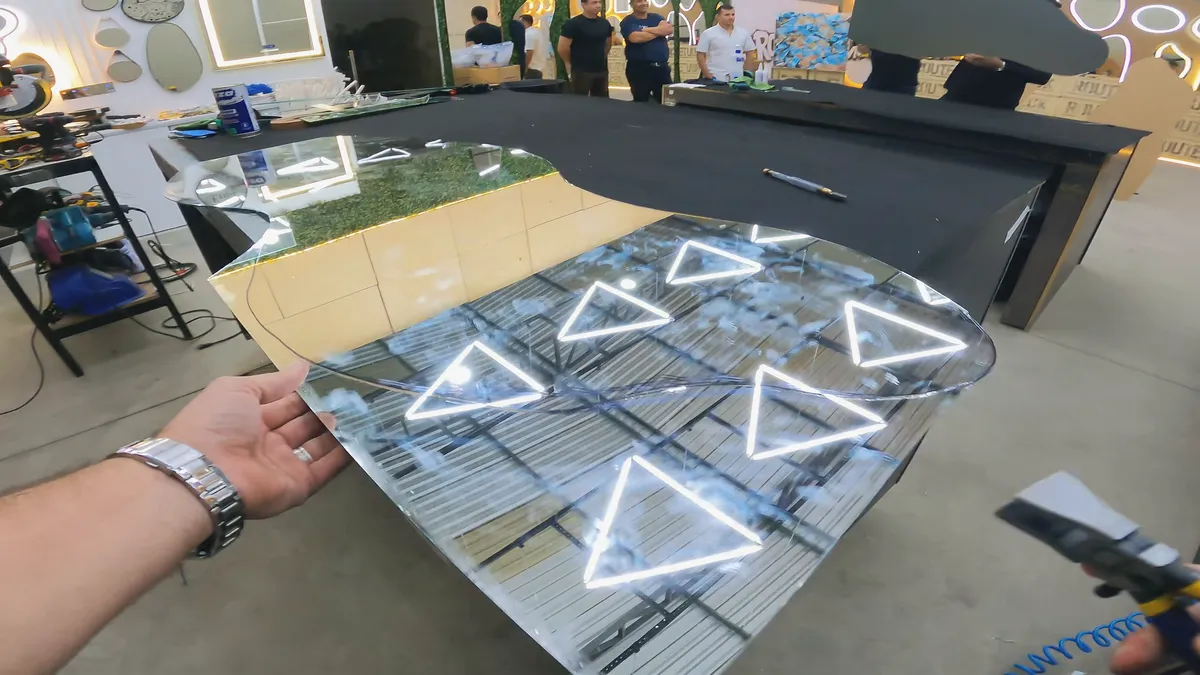
What was said at the bench the minute it cracked
The contestant explained it in one line: during break-out, he tapped it and it broke. And someone watching from the side gave the advice that works in any shop: just be careful so it does not chip any further. Right after came the bet: I think it will hold.
Notice the order. Nobody told him to drop the piece or to rush to finish. The first concern was keeping the crack from spreading. He kept working carefully until time ran out and handed in the cracked mirror for judging. That is keeping your cool, and keeping your cool can be trained too.

Cracked mirror: what to do right away
- Stop tapping, pulling and forcing. Cracks spread with impact and twisting.
- Rest the whole piece on a flat surface, with no corner hanging in the air.
- Put on gloves before you handle it again: a crack can drop shards without warning.
- Find where the crack starts and where it ends. Mark the tip with a marker.
- Check whether it ran into the design or stayed in the offcut. That decides everything else.
- Only then go back to breaking out, from the side opposite the crack and in smaller pieces.
Crack in the piece or crack in the offcut
If the crack stayed in the offcut and stopped before the score line, the piece can still be saved. Remove the offcut slowly, in small pieces, starting away from the crack, so you do not push force toward it. If the crack ran into the design, it is a different story: that mirror does not go to the customer. Cracked glass never becomes whole again, and the crack tends to grow with the pressure of installation, wall vibration and the temperature swings of a bathroom.
Sometimes you can still use the sheet for a smaller piece, cutting below the crack with some margin. In a timed challenge there is no time for that. In a glass shop, a large mirror that cracked can become a smaller piece for another order, and that cuts the loss a lot.
| Where the crack is | Can it be saved? | What to do |
|---|---|---|
| Only in the offcut, stopped before the score | Yes | Remove the offcut in pieces, starting away from the crack |
| In the offcut, touching the score | Maybe | Break out from the other side and check the edge when edging |
| Inside the design | Not for this order | Set the sheet aside for a smaller piece or throw it out |
In a challenge a crack does not knock you out; with a customer it does
In the EP3 judging, Vinícius was fair to both: one came closer to the drawing but had the bad luck of his mirror cracking, and the other did not crack but ended up far from the template. The judges weighed both mistakes. In EP1 the same idea had already come up another way: with a contestant edging an inside curve, the talk at the bench boiled down to this: if he breaks the mirror, he is out.
With a customer there is no tie. A cracked mirror is a mirror you make again, with a new sheet, machine time and a missed deadline. That is why the best decision in the minute after a crack is to protect the sheet and the rest of your material, not the piece that is already lost.
How to avoid getting there
Almost every break-out crack starts earlier: a score that skipped, a score that was run over twice, the wrong order when opening the cuts, or a mirror squeezed later in its frame. The three posts linked at the end cover that. And on a CNC router like the Router Glass, the machine makes the continuous score.
- My mirror cracked while cutting. What should I do first?
- Stop forcing it, rest the whole piece on a flat surface, put on gloves and mark where the crack ends. Then decide whether it stayed in the offcut or ran into the design.
- Can I use a cracked mirror if the crack is small?
- If it ran into the design, not for a customer: the crack tends to grow with installation, vibration and temperature. If it stayed in the offcut, the piece can still be broken out carefully.
- How did the judges score the mirror that cracked in EP3?
- They weighed both mistakes: the cracked mirror was the closest to the drawing, and the other one did not crack but was far from the template. It ended in a tie.
Lost a mirror to a crack and want to talk about it? Message me on WhatsApp at +55 31 9095-8383.
Full episode 3 · Scoring glass with a diamond cutter · How to break out a mirror without chipping · Gap between mirror and metal frame · Router Glass: CNC mirror cutting